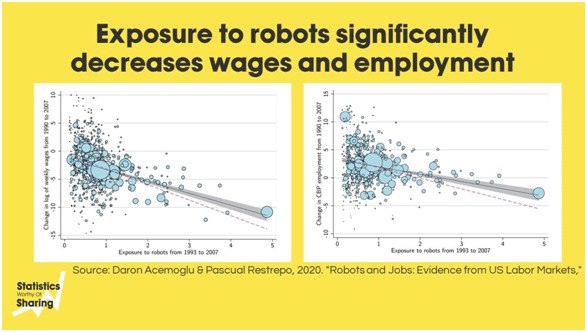
The two graphs show the impact of exposure to robots from 1993 to 2007 in commuting zones (geographical area) on changes in employment and weekly wages from 1990 to 2007 in the US. Exposure to robots in each commuting zone is measured as the sum over industries of the local employment share of industry times the national penetration of robots into that industry. The robots considered in the paper are industrial robots and are defined by the International Federation of Robotics as “an automatically controlled, re programmable, and multipurpose [machine]”. The dots’ size indicate the share of the 1990 US working age population in the corresponding commuting zone. The interpretation: The graphs retrieved from the paper “Robots and Jobs: Evidence from US Labor Markets” by Acemoglu and Restrepo (2020) show that wages and employment significantly decrease with exposure to robots. Indeed, the blue regression line is negative and significant in both graphs. In addition, the coefficients are still significantly negative when the top 1% of the commuting zones with the highest exposure to robots is excluded (red dotted line). Theoretically, there are different mechanisms through which robots or other automation technologies can impact the labour market. The negative impact comes from the displacement of workers. As a matter of facts, estimations from the World Bank predict that 57 percent of jobs in the OECD could be automated in the next two decades. However, there are also positive effects through increasing productivity of workers and creation of new activities. This is what happened during the interwar period. Around this time, the telegraph has been replaced by better communication technologies and there has been a lot of improvement in the transportation sector. However, although some professional activities disappeared because of technological improvement, the new activities that appeared absorbed those displaced workers and the progress in education allowed to facilitate this reallocation of labour. Thus, technological progress has been associated with improvements of the condition of workers. However, other historical events have shown how the displacement effect could hurt workers, such as in early 1800 when the Luddites rebelled against the introduction of textile machinery, which threatened their skilled craft. Given the rapid paste at which automation technologies and artificial intelligence are developing, it is important to be prepared and develop programs that would help mitigate the negative impact of displacement. In addition, as has been shown in the interwar period, education might help to reallocate workers to more skill-intensive sectors.
Source: Daron Acemoglu & Pascual Restrepo, 2020. “Robots and Jobs: Evidence from US Labor Markets,” Journal of Political Economy, vol 128(6), pages 2188-2244.